AT THE HEARTH OF OUR THINKING
THE DIFFERENT CONCEPTS AND MATERIALS
20 Sep 2020
RECYCLABLE:
A product is recyclable when, at the end of its life, it can be reintroduced into the production cycle to replace some or all of the new material that is normally used to make a product.
- Most of the virgin raw materials that we use are themselves recyclable through traditional sorting channels:
Plastic : PE (HDPE , LDPE, …); PP ; PET
Glass
Aluminium
RECYCLED MATERIAL:
- PCR (Post consumer recycled): Material that is sorted after use by the consumer, to be used again in the production of new packaging
- PIR (Post industrial recycled): Material derived from industrial waste.
Benefits: The waste is easily collected and sorted in the facilities it came from, and can be quickly reprocessed into raw material.
- The following materials may be made up by EMBELIA in whole or in part of recycled material: Plastic (PE, PP, PET), Aluminium (Jars), Glass
BIO-BASED PLASTIC:
A bio-based plastic is a plastic derived from renewable resources (sugar cane, maize, soy) as opposed to plastic made from fossil materials (oil).
- EMBELIA uses bio sourced-based PE in the production of some of its flagship ranges.
Bio-sourced PE leads to a reduction in global warming through the absorption of CO2 from the atmosphere as the sugar cane grows.
BIODEGRADABLE:
A product is biodegradable if after use it can, under appropriate conditions, be decomposed naturally under the action of living organisms (microorganisms).
REFILLABLE OR REUSABLE :
A packaging is refillable or reusable when the consumer after the use of the product wash it and refill it to re-use it.
These articles might be of interest
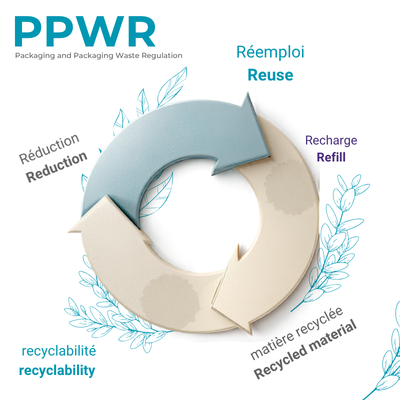
:PPWR: Anticipating New Packaging Requirements
 27 Jul 2026
PPWR: 2030 starts today
Preparing for the PPWR starts today, not in 2030.
From 2030, the PPWR will introduce new requirements, particularly regarding recyclability and the incorporation of recycled material into plastic packaging.
For brands, the challenge is not simply to replace virgin resin with recycled resin. Technical performance, formula compatibility, aesthetic appearance, material availability and regulatory compliance must all be taken into account.
EMBELIA supports its clients in identifying solutions tailored to their projects, balancing regulatory developments, quality, functionality and design.
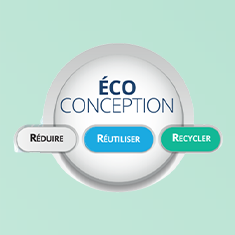
ECO-DESIGN - THE 3 RS
 04 Oct 2022
Life cycle analysis (LCA) is a tool used to assess the environmental impact of a product and to identify eco-design approaches
This approach is based on the 3 Rs that are the fundamental principles of the circular economy
Material characteristics
 29 Sep 2022
EMBELIA offers you a sum up describing the characteristics of the materials. This table shows you the recyclability of the different raw materials.
PACAKGING COLLECTION AND SORTING
 25 Sep 2022
How to identify a recyclable and recycled packaging ? How to recognize recycled materials ? What are the sorting instructions for our packaging?
- PPWR: Anticipating New Packaging Requirements PPWR, recyclability, recycled materials, eco-design: EMBELIA supports brands in adapting their packaging to meet new European requirements.
- ReSource eco-designed refill | PET / RPET refill bottle ReSource eco-designed refill | PET / RPET refill bottle
- ECODESIGN - REFILLABLE PACKAGING REFILL
- CLASSIC JAR - LIGHTWEIGHT, REFILLABLE AND RECYCLED ! ECOCONCEPTION POT
- LIDS, CAPS AND OVERCAPS Wood you take some more accessories ?
- RECYCLAGE CHIMIQUE ET ALLOCATION MASS BALANCE RECYCLAGE CHIMIQUE ET ALLOCATION MASS BALANCE